
“The main thing is to keep the main thing the main thing.”
— Stephen R. Covey
Supporting the Implementation of My CCMR Innovation Plan
Introduction
Implementing an innovation plan requires more than identifying a problem and proposing a solution—it requires intentionally influencing behavior change within an organization. This influencer strategy outlines how the Six Sources of Influence framework will support the successful implementation of my CCMR innovation plan by focusing on the behaviors, systems, and collaborative structures necessary to improve student readiness outcomes.
In my role as a CCMR coordinator, I have observed that initiatives are most successful when staff members have clear expectations, practical support systems, and opportunities to collaborate around shared goals. This strategy identifies the results we want to achieve, the vital behaviors that will drive those results, and the organizational influences that will support sustainable implementation.
This page serves as the execution component of my innovation plan, explaining how the proposed changes will move from planning into consistent practice.
Part A: Influencer Strategy Foundations
Results to Achieve:
- Increase FAFSA completion rates by 20% by the end of the academic year.
- Increase student college application submissions by 25%.
- Improve student engagement in career readiness activities (e.g., career workshops, military interest meetings) by 30%.
Measurement:
- Track FAFSA submission via district portal.
- Track college applications submitted through guidance offices.
- Monitor student attendance in career readiness activities and workshops.
- Survey student confidence in college and career planning before and after interventions.
Vital Behaviors to Change:
- Students completing FAFSA and scholarship applications on time.
- Students submitting college applications and resumes.
- Students actively participating in career readiness workshops and military enrollment programs.
Organizational Influencers:
Parents/Guardians: Provide support and motivation for completing applications.
Administrators: Provide policies, allocate resources, and model the importance of CCMR tasks.
Counselors and Teachers: Support students directly, provide guidance, and reinforce behaviors.
Peers: Encourage and normalize participation in CCMR activities.
Part B
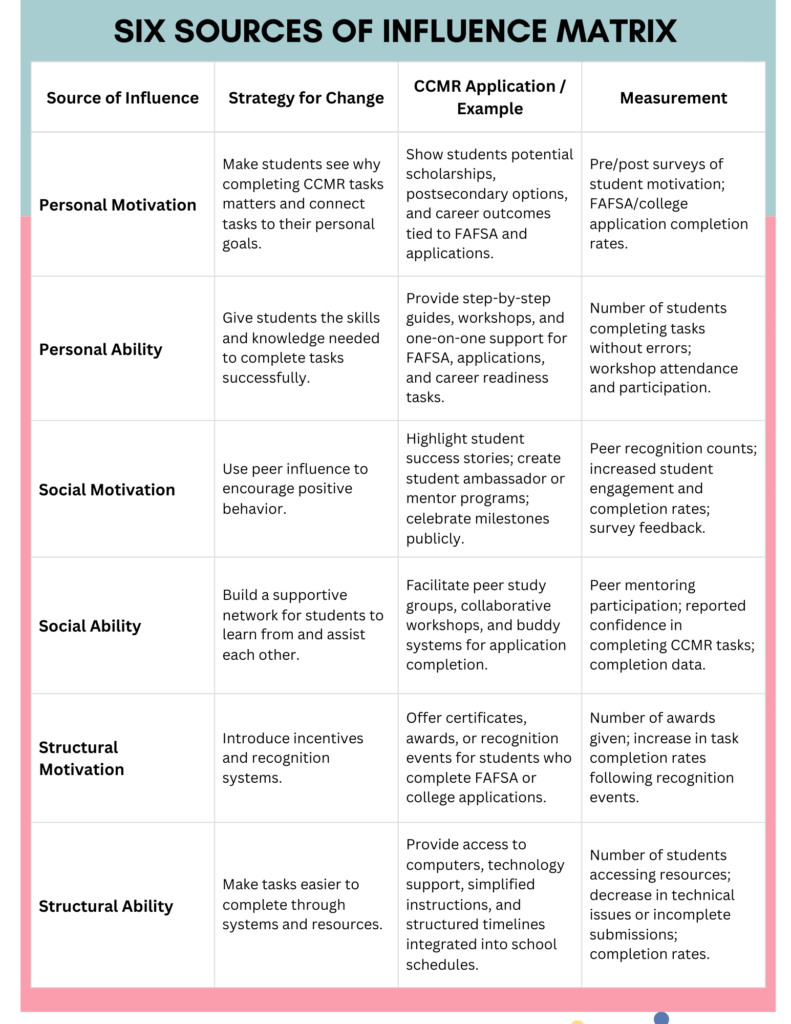
Six Sources of Influence Strategy Matrix
Why This Strategy Matters
The Six Sources of Influence framework shows that behavior change is most successful when multiple sources of influence work together. Relying on motivation alone rarely produces lasting change (Grenny, Patterson, Maxfield, McMillan, & Switzler, 2013). In CCMR work, initiatives often struggle not because educators lack commitment, but because systems, routines, and support structures are not aligned with the desired behaviors.
By intentionally addressing motivation, ability, collaboration, and organizational systems, this influencer strategy helps ensure that CCMR practices become embedded in daily routines rather than existing as temporary initiatives. This alignment increases the likelihood that the innovation plan leads to measurable improvements in student readiness outcomes.
References
Covey, S., McChesney, C., & Huling, J. (2012). The 4 disciplines of execution: Achieving your wildly important goals. Simon and Schuster.
Grenny, J., Patterson, K., Maxfield, D., McMillan, R., & Switzler, A. (2013). Influencer: The new science of leading change (2nd ed.). McGraw-Hill Education.
All Washed Up. (n.d.). [Video]. YouTube. https://youtu.be/wu7UBY5euBg