Executing Change: 4DX Implementation Strategy
Digital Career Exploration & Mentorship Program
Erica Cedillo
Lamar University
Professor Padovan
Leading Organization Change-EDLD 5305
Purpose & Audience
Turning an innovative idea into meaningful change requires more than a strong vision, it requires disciplined execution. As explained in The 4 Disciplines of Execution, organizations often struggle to achieve their goals because of what the authors call the “whirlwind,” the constant day-to-day demands that distract from strategic priorities (McChesney, Covey, & Huling, 2016). This 4DX strategy provides a focused roadmap to ensure my Digital Career Exploration & Mentorship Program moves beyond a proposal and into effective practice.
This plan is designed for HISD CCMR leadership, high school principals, counselors, instructional coaches, and pilot campus teams who will support implementation. By focusing on clear goals, measurable progress, and consistent accountability, this strategy outlines how the program will move from vision to measurable outcomes while expanding equitable access to career exploration and mentorship opportunities for students.
The Wildly Important Goal (WIG)
Discipline 1: Focus on the Wildly Important Goal
If everything is important, nothing is important. As described in The 4 Disciplines of Execution, execution begins by narrowing focus to one goal that must be achieved despite competing priorities.
Our WIG:
By the end of Year 1 (pilot year), 75% of participating students will complete at least three structured mentor sessions and two virtual career lab simulations, demonstrating a 10% increase in career knowledge and improved self-efficacy scores.
This WIG aligns directly to district CCMR metrics and reflects both cognitive and noncognitive growth.
Why this WIG matters:
- It prioritizes engagement before expansion.
- It establishes measurable proof of concept.
- It centers student outcomes rather than tool adoption.
Discipline 2: Act on the Lead Measures
Lag measures tell us if we achieved the goal.
Lead measures tell us if we are likely to achieve the goal.
Lag Measures (Results We Want)
- 75% student completion of 3+ mentor sessions
- 2+ completed career simulations per student
- 10% increase in career knowledge (pre/post survey)
- Growth in student self-efficacy ratings
- FAFSA completion, certification attempts, SAT/TSI participation (aligned to CCMR indicators)
Lead Measures (Actions We Control Weekly)
- Weekly Mentor Engagement Tracking
- % of students scheduled for mentor sessions
- % of completed mentor check-ins
- Simulation Implementation Rate
- Number of students completing structured VR labs per month
- Reflection submissions tied to each simulation
- Mentor & Staff Fidelity Checks
- Monthly mentor touchpoint meetings
- PLC discussions focused on implementation barriers
Lead measures are predictive and influenceable. If weekly mentor engagement drops, we intervene immediately rather than waiting for end-of-semester data.
Discipline 3: Keep a Compelling Scoreboard
People play differently when they are keeping score.
The scoreboard will be visible to:
- Campus administrators
- Counselors
- CCMR leads
- Pilot teachers
The Scoreboard Will Track:
- % of students matched with mentors
- % of active mentor sessions completed
- Simulation completion rates
- Student growth trends (career knowledge & self-efficacy)
Importantly, the scoreboard will not rank campuses competitively. Instead, it will highlight growth and momentum.
We will use dashboard design principles supported by Holstein, McLaren, and Aleven (2019) to ensure clarity and avoid data overload.
Students will also have a simplified progress tracker so they can see their own growth journey.
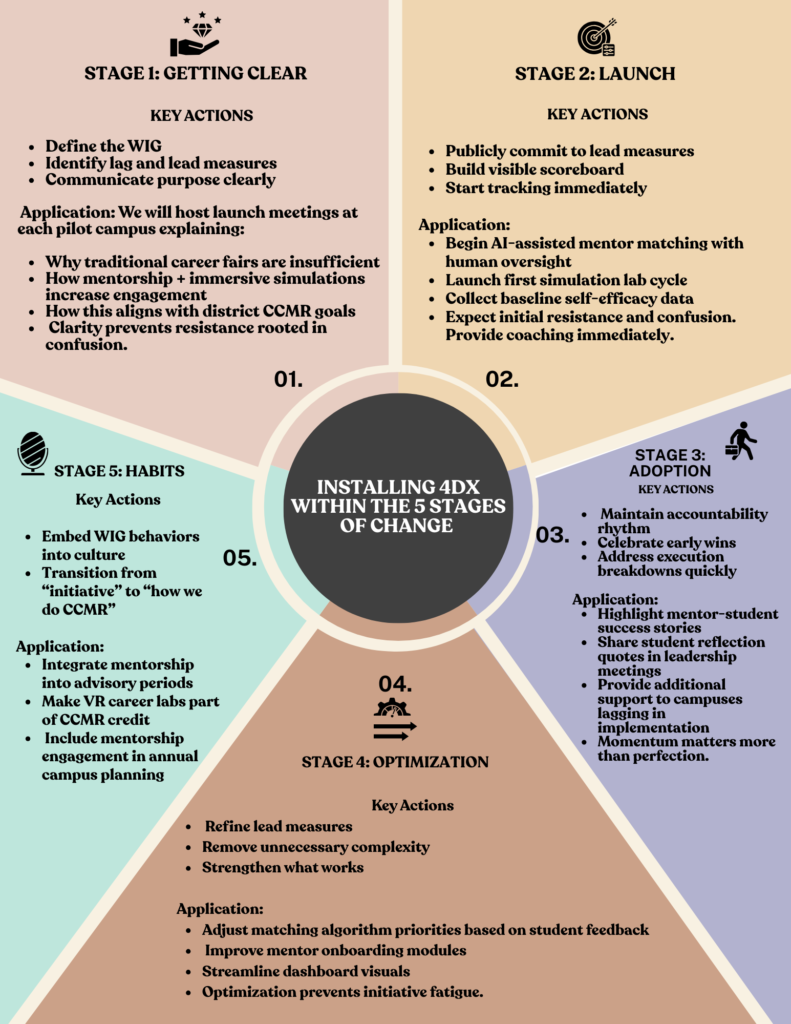
Installing 4DX Within the 5 Stages of Change
According to The 4 Disciplines of Execution, teams move through five predictable stages.
How the Influencer Model Complements 4DX
While The 4 Disciplines of Execution (4DX) focuses on how to execute a strategy, the Influencer Model focuses on changing the behaviors that make that strategy successful. According to Influencer: The New Science of Leading Change, lasting change happens when leaders address multiple sources of influence. This initiative uses four of those areas to support implementation:
Personal Motivation
Staff need to see why the work matters. Sharing student impact stories and showing how mentorship reduces disengagement helps build that connection.
Personal Ability
Teachers and mentors will receive training and professional development so they feel prepared. Technical coaching will also help staff confidently use dashboards and simulation tools.
Social Motivation
Recognition helps reinforce positive change. Mentor champions will be highlighted, and campuses will celebrate progress as the program grows.
Social Ability
Collaboration will support expansion. In Year 2, campuses will mentor one another while PLCs provide space for sharing strategies and solving challenges together.
In this approach, 4DX provides the structure for execution, while the Influencer Model helps people actually change their behavior. Together, they create both accountability and genuine buy-in.
What We Need to Be Successful
For this initiative to succeed, several supports must be in place:
- Dedicated CCMR time within the master schedule
- Funding for the AI mentor-matching platform and VR simulations
- A diverse mentor recruitment pipeline
- Data analyst support to keep dashboards clear and useful
- Principal commitment to protect focus on the WIG
Even strong strategies struggle without the right structural support.
Expected Impact
If implemented well, this program can:
- Increase career clarity for students
- Strengthen student confidence and persistence
- Improve CCMR outcomes across the district
- Expand equitable access to mentorship
- Shift career exploration from one-time events to an ongoing learning experience
Ultimately, this is more than a technology initiative.
It represents a shift in how we prepare students for life after graduation.
References
Grenny, J., Patterson, K., Maxfield, D., McMillan, R., & Switzler, A. (2013). Influencer: The New Science of Leading Change. McGraw-Hill Education.
McChesney, C., Covey, S., & Huling, J. (2016). The 4 Disciplines of Execution. Free Press.
Holstein, K., McLaren, B., & Aleven, V. (2019). Designing student-facing learning analytics. Journal of Learning Analytics, 6(2), 1–17.