Blog # 5
Leading Forward
Leadership is rarely a straight path. It shifts, it bends, and it often forces us to look inward more than outward. This week, as I reflected on the concept of feedforward, I found myself thinking deeply about how this practice intersects with my own leadership journey, especially in my role as a CCMR Coordinator supporting high school seniors as they prepare for life after graduation.
Every day in my position, I work closely with seniors completing Texas College Bridge, scheduling their TSI testing, navigating admissions steps, and pushing through those final months of high school. Seniors are wonderfully complex, they are confident one moment, overwhelmed the next, and always trying to figure out what the future holds. Walking beside them through the highs and lows of college readiness has shaped me as much as I hope I have shaped them.
And as I have learned through this process, the same growth mindset I encourage in my students is the mindset I must continue to cultivate in myself as a leader.
Balancing Leadership With a Growth Mindset
The more I grow, the more I realize leadership isn’t about perfection, it i’s about progression. Dweck (2006) notes that a growth mindset revolves around the belief that abilities can be developed through dedication and hard work. This feels especially relevant in the world of education, where policies change, student needs evolve, and new initiatives (like Texas College Bridge) require ongoing adaptation.
Maintaining a growth mindset while leading others requires humility, an understanding that I do not and will not ever have all the answers. As a CCMR leader, my effectiveness depends on how well I’m able to stay flexible, learn from experience, and continually refine my practices. Some days, that means reevaluating how I communicate deadlines to students. Other days, it means recognizing that a new system isn’t working and pivoting quickly.
Northouse (2022) reminds us that leadership is a process, not a position. This framing allows me to embrace mistakes not as failures, but as fuel, guiding me to lead more effectively with each new challenge.

What Receiving Feedforward Has Taught Me
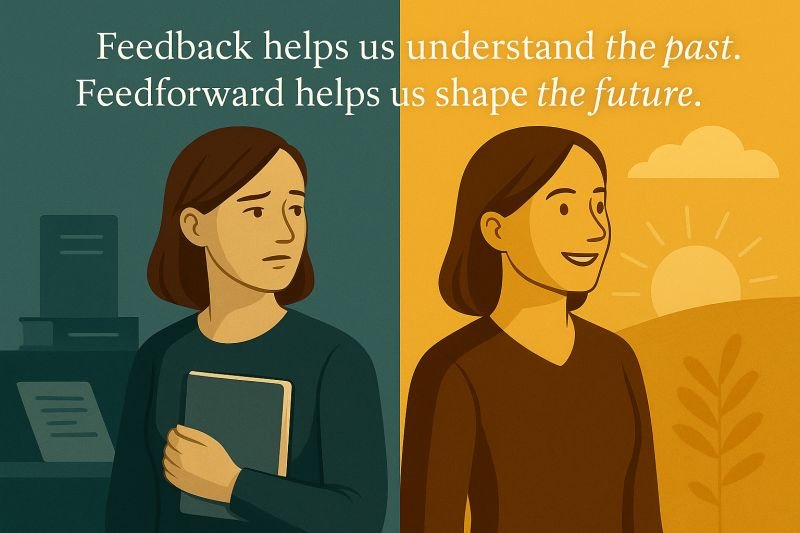
Feedforward, as originally conceptualized by Marshall Goldsmith (2002), is distinct from feedback because it focuses on future possibilities rather than past errors. Receiving feedforward during this course has been eye-opening. Unlike traditional feedback, which can sometimes make us relive mistakes, feedforward invites us to lean into what could be better.
Here are the biggest lessons it has taught me:
1. Feedforward is growth in motion.
Instead of analyzing what I did wrong, I found myself excited about how I could improve. This forward-facing perspective aligns with Kouzes and Posner’s (2017) belief that leadership is rooted in continuous learning and the pursuit of better practices.
2. It reduces defensiveness and increases reflection.
Because feedforward is framed around opportunity instead of criticism, I felt more open to receiving it. It didn’t feel like a personal evaluation, it felt like a roadmap.
3. It encouraged me to see leadership as relational.
Leadership expert Heifetz (1994) emphasizes the importance of adaptive leadership, learning from others and continuously adjusting to new circumstances. Feedforward reinforces this kind of adaptability because it requires listening, reflecting, and accepting that others see angles we may overlook.
Most importantly, I realized that feedforward is not just about improvement, it’s also about trust. When someone offers you direction for the future, it is a sign they believe in your capacity to grow into it.
How I Will Apply Feedforward to My Leadership Style
As I think about the kind of leader I want to be for my students and for my colleagues, I see feedforward becoming a central part of how I work and interact with others.
1. I will intentionally seek suggestions rather than waiting for problems.
Instead of asking “How did I do?” I want to start asking, “What is one thing I can do better next time?” This keeps the focus on improvement instead of evaluation.
2. I will model open growth for my students.
If I expect students to embrace learning, I must show them what that looks like. Whether I’m navigating changes to Texas College Bridge or adjusting how I support TSI readiness, I want them to see that leaders are learners too.
3. I will create team environments where feedforward feels safe.
Northouse (2022) notes that effective leadership fosters trust. By normalizing suggestions and reducing the stigma around improvement, I can help create a culture where growth is a shared value.
4. I will turn insights into action.
Feedforward is useless unless it transforms behavior. For me, that means taking the suggestions I receive, communicate more frequently, simplify processes, streamline checklists and implementing them intentionally.

Closing Reflection
At the end of this week, one message keeps echoing in my mind:
“Leadership is not about being the best—it’s about becoming better.”
As a CCMR Coordinator, my leadership directly affects students who are preparing to step into the rest of their lives. That’s a responsibility that demands growth. Feedforward has reminded me that leadership is shaped not by what we avoid, but by what we’re willing to confront and improve.
In helping students move forward, I must be willing to move forward too.
References
Dweck, C. S. (2006). Mindset: The new psychology of success. Random House.
Goldsmith, M. (2002). Try feedforward instead of feedback. Leader to Leader, 25(1), 11–15.
Heifetz, R. A. (1994). Leadership without easy answers. Harvard University Press.
Kouzes, J. M., & Posner, B. Z. (2017). The leadership challenge (6th ed.). Jossey-Bass.
Northouse, P. G. (2022). Leadership: Theory and practice (9th ed.). Sage Publications.