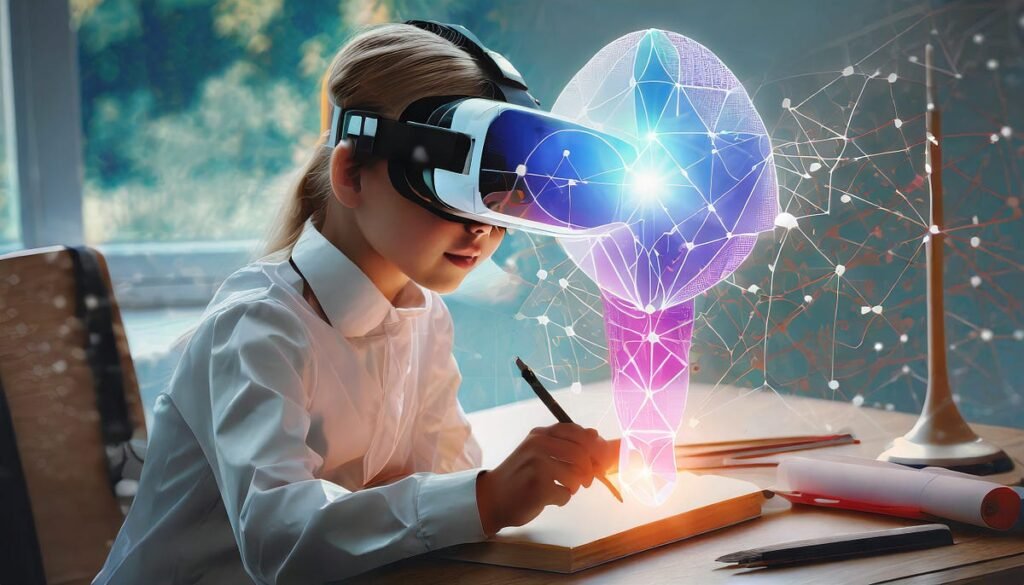
How Augmented Reality (AR) Is Transforming Classroom Learning
If you walked into a typical classroom a decade ago, the most high-tech item you’d probably notice was a projector or a cart of shared laptops. Today, teachers can hold up a tablet and instantly place a beating human heart in the center of the room or transform an empty desk into a simulated chemistry lab. This is the world of Augmented Reality (AR), and while it still feels futuristic, it’s quickly becoming a natural and powerful part of how students learn. What makes AR so exciting is the way it blends imagination with experience. Instead of just reading about a scientific concept or seeing a static picture, students can actually interact with it. They can rotate objects, zoom in, break them apart, and explore them from different angles. Unlike Virtual Reality, AR doesn’t require bulky headsets. For many classrooms, a tablet or phone is all it takes to open a new kind of learning environment.
AR in the Science Classroom: Turning Curiosity Into Discovery
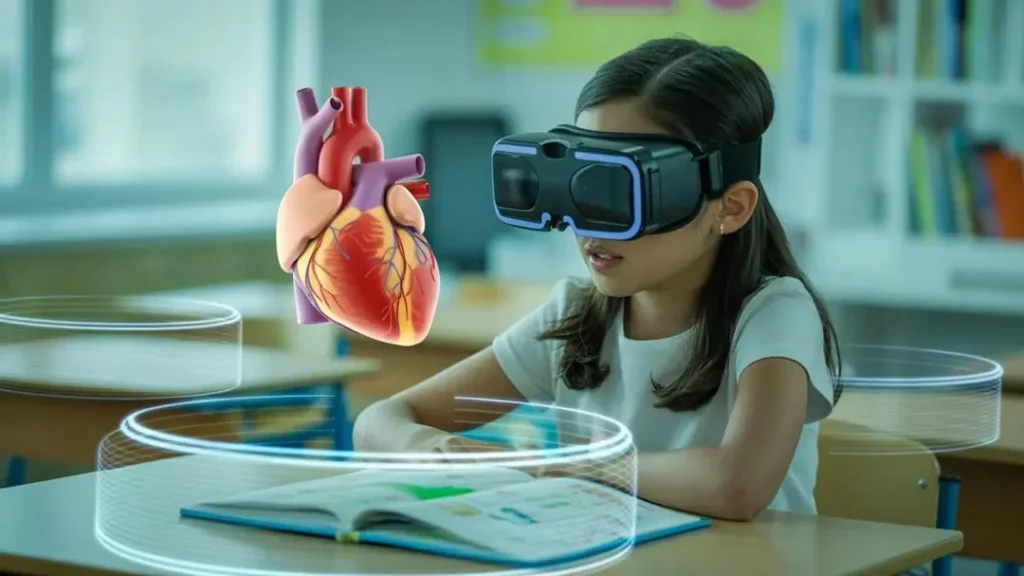
Science teachers often wish they had a way to help students “see inside things,” and AR comes very close to granting that wish. Rather than staring at textbook diagrams, students can use AR apps to explore a 3D model of a cell floating above their desk. They can peel back layers, examine organelles, and make real-time observations. I once saw a biology lesson where the teacher used AR to project a life-sized human heart in the middle of the room. Students walked around it, listened to the valves open and close, and tapped for information on each chamber. The room buzzed with excitement, not because it was “cool,” but because students felt like they were genuinely discovering something. Research shows that AR tools significantly enhance student engagement and understanding by making abstract concepts more tangible (Akçayır & Akçayır, 2017). Chemistry classes see similar benefits. Rather than relying on flat images to represent molecules and reactions, students can manipulate interactive models. They can visualize how atoms bond, what happens when elements combine, and how chemical processes unfold all while avoiding the safety issues or cost barriers of real experiments.
AR in Career Exploration: Making Futures Feel Real
One major challenge in career readiness is helping students participate in experiences that show them what different careers are actually like. Not every student can visit a hospital, engineering lab, or construction site. AR makes those experiences more accessible. Imagine a student who is curious about becoming a nurse. Using AR, they can explore a 3D hospital room, identify equipment, and practice basic tasks like taking vitals or preparing medical tools. A student interested in welding or automotive repair can interact with digital equipment, practicing motions and gaining familiarity before stepping into a real workshop. Research suggests that AR not only improves understanding, but also increases motivation by giving learners a sense of agency and immersion (Garzotto, 2017). This matters for career exploration, students are not just reading about jobs they are virtually stepping into them. For students who may not have transportation, financial resources, or opportunities to shadow professionals, AR levels the playing field. It offers windows into careers they might not otherwise experience.
AR for Skill Development: Practice Without Pressure
One of the biggest advantages of AR is the ability to let students practice skills without the fear of making a mistake. Whether it’s practicing CPR compressions, assembling an engine part, or rehearsing public speaking in a simulated environment, AR allows students to learn safely and confidently. In career and technical education, AR can guide students through step-by-step processes overlayed directly on real equipment. For example, when learning engine repair, AR can label parts, highlight steps, and point out errors in real time. In culinary classrooms, students can practice motion-based skills with AR guidance before using sharp tools. Teachers often say that AR gives hesitant students courage and they are more willing to try, explore, and take risks because the stakes feel manageable. It turns learning into a space for experimentation, not perfection.
Why AR Works: Engagement Meets Meaningful Learning
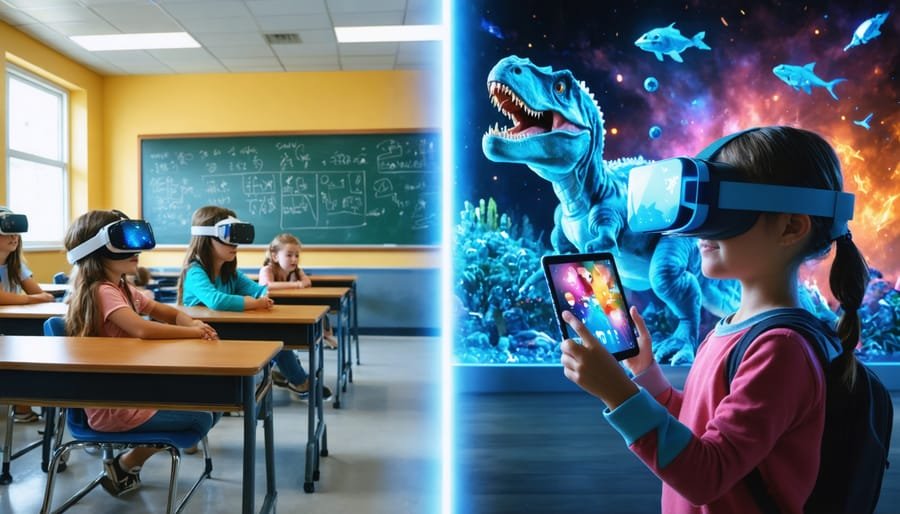
While the initial “wow factor” of AR is fun, the real impact comes from how it supports deeper learning. Students take more ownership of the process. They ask more questions. They make stronger connections between what they see, what they touch, and what they understand. AR doesn’t replace good teaching but it enhances it. It gives students tools to visualize, interact, and explore in ways that traditional methods can not always capture.
A Glimpse Into the Future
We are still at the beginning of what AR can do in education. As the technology becomes more affordable and widely adopted, we will likely see even more classroom applications such as more career simulations, more interactive labs, more opportunities for students to engage with content in meaningful, memorable ways. For today’s students, AR is not just a tech trend, It is a tool that helps them see the world and their future in a new light.
References
Akçayır, M., & Akçayır, G. (2017). Advantages and challenges associated with augmented reality for education: A systematic review of the literature. Educational Research Review, 20, 1–11. https://doi.org/10.1016/j.edurev.2016.11.002
Garzotto, F. (2017). Interactive storytelling for children with autism: A critical analysis. Proceedings of the 2017 Conference on Interaction Design and Children, 103–112. (Includes discussion on AR’s impact on engagement and motivation.)
Billinghurst, M., & Duenser, A. (2012). Augmented reality in the classroom. Computer, 45(7), 56–63. https://doi.org/10.1109/MC.2012.111